A lawn disease can be one of the most frustrating things a homeowner deals with. You water, you mow, you do everything by the book, and brown patches still show up out of nowhere. The hard truth is that our South Central PA climate does a lot of the deciding for you.
In this article, we’ll walk through the lawn diseases we see most often in South Central Pennsylvania, how to tell them apart from other lawn problems, and what actually helps (and what doesn’t). We’ll also be straight with you about what professional lawn care can and can’t do for a diseased lawn.
Jump to:
- Why lawn diseases show up in South Central Pennsylvania
- Common signs of lawn fungus
- The lawn diseases we see most in South Central PA
- What actually helps prevent lawn disease
- FAQs about lawn disease control in South Central PA
- Choosing lawn care in South Central Pennsylvania
Why lawn diseases show up in South Central Pennsylvania
Grass diseases can happen anywhere, but our hot, humid summers make them especially common here. High humidity, heavy clay soils that hold moisture, and warm nights create close to ideal conditions for fungus to take hold and spread.
Nearly every lawn disease needs three things to line up at once, often called the disease triangle:
- A susceptible host (your grass)
- A disease-causing organism (the fungus itself)
- A favorable environment (warm, wet weather)
Take away any one of those and the disease struggles. That’s worth remembering, because it’s also the key to prevention. You can’t control the weather, but you can influence the health of your grass and the moisture around it.
The good news: many lawn fungus problems clear up on their own once the weather turns. A stretch of dry, cooler days often does more than any product.
Common signs of lawn fungus
Different diseases show up differently, but these are the signs that most often point to lawn fungus:
- Circular brown or yellow patches
- Spots or lesions on individual grass blades
- Slimy or powdery growth
- Reddish or pink stringy growth (a telltale sign of Red Thread)
Keep in mind that other problems can mimic these symptoms. Insect damage, in particular, is often mistaken for disease, and both can leave brown patches behind.
If you’re not sure what you’re looking at, it’s worth asking a lawn care professional before you treat anything. Treating the wrong problem can make it worse. A common example: homeowners see brown patches, assume it’s drought, and start watering more, which can actually feed the fungus and help it spread.
The lawn diseases we see most in South Central PA
There are dozens of lawn diseases, but three account for most of what we see across South Central Pennsylvania: Brown Patch, Dollar Spot, and Red Thread. Here’s how to recognize each.
Brown Patch
True to its name, Brown Patch shows up as circular, brownish-yellow patches. It thrives in heat and humidity, especially when nighttime temperatures stay above 68°F and daytime highs reach 85°F or more, which describes a typical stretch of a South Central PA July.
Brown Patch is one of the trickier diseases to diagnose, because so many things cause brown spots. Insect damage tends to look more irregular and uneven, showing up wherever the pest is feeding. Drought usually covers larger, broader areas. There are always exceptions, though, so when in doubt, have someone take a look.
Dollar Spot
Dollar Spot appears as small, straw-colored circles roughly the size of a silver dollar, which is exactly how it got its name. The patches start small but can grow together and spread as the disease progresses.
It’s sometimes confused with Brown Patch once the circles merge. The giveaway is the size: those small, distinct silver-dollar circles are the identifying feature.
Red Thread
Red Thread is one of the easier diseases to identify. You’ll see reddish-pink, stringy threads woven through patches of grass. That distinctive color and texture make it stand out from most other lawn problems. Red Thread often shows up on lawns that are low on nitrogen, which is one reason a consistent fertilization program helps keep it in check.
What actually helps prevent lawn disease
Here’s the honest part: even when you do everything right, lawn disease can still show up. Weather is the single biggest factor, and it’s completely out of your hands. There is no way to guarantee a disease-free lawn, and anyone who promises one isn’t being straight with you.
What you can do is lower the odds and slow a disease down once it starts. It comes back to that disease triangle: make your grass healthier and the environment less friendly to fungus.
Watering habits
Because fungus thrives in moisture, watering is the lever you have the most control over. If disease is active, back off on watering and let the lawn dry out.
As a rule, water early in the morning so the grass has all day to dry. Watering in the evening leaves moisture sitting on the blades overnight, which is exactly what fungus wants.
Mowing
Mowing matters more than most people think. Cutting too short stresses the grass and weakens its ability to fight off disease. Never remove more than one-third of the blade at a time, and mow to the recommended height for your grass type. Keeping your mower blades sharp helps too, since a clean cut heals faster than a torn one.
Airflow and lawn density
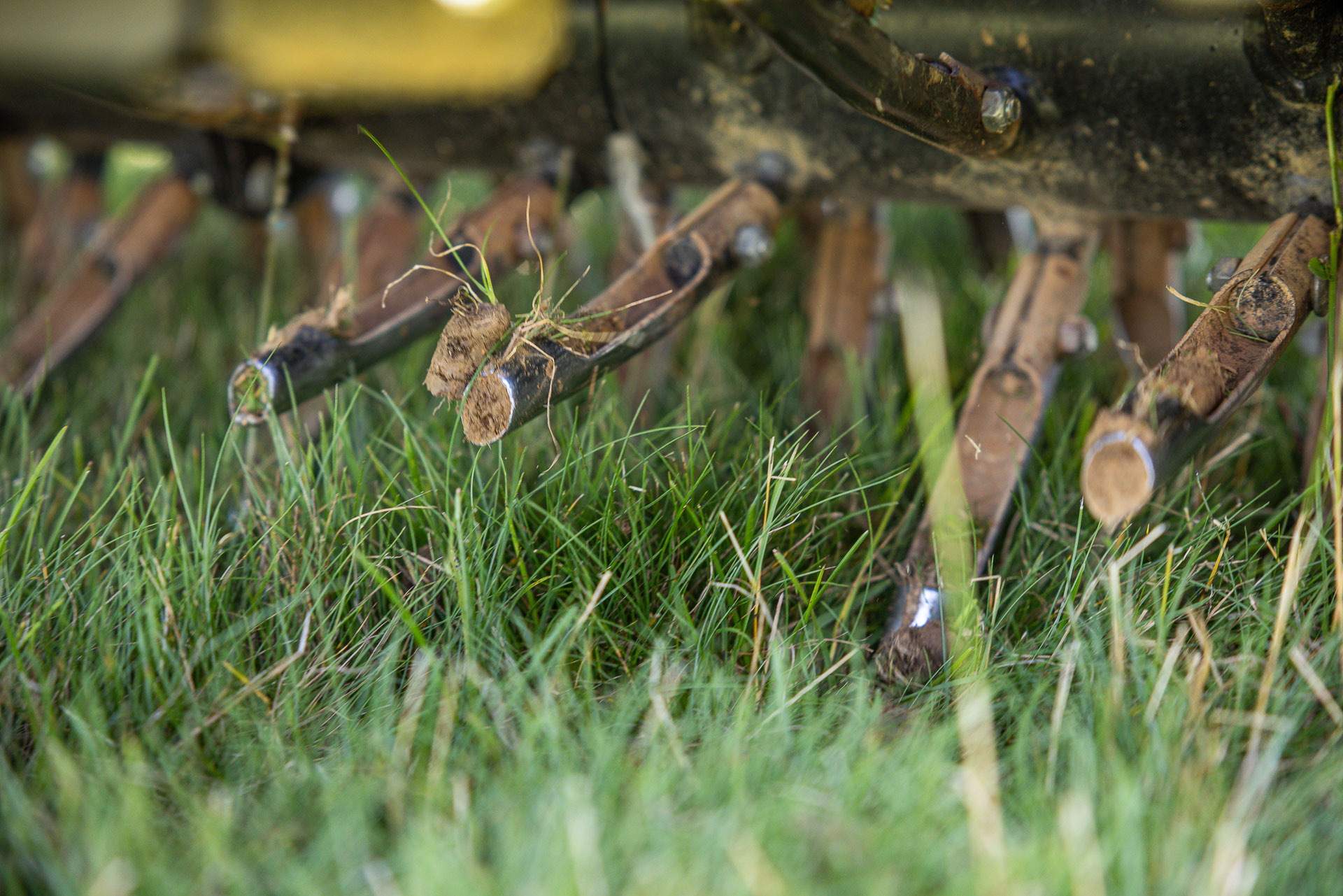
Compacted soil stays wet and invites fungus. Aeration relieves that compaction and helps the soil drain and breathe, which is why it plays a real role in disease control.
A thick, healthy lawn also crowds out disease better than a thin one. Thinned-out grass is where disease does the most damage. Staying consistent with fertilization and overseeding keeps the lawn dense enough to defend itself.
FAQs about lawn disease control in South Central PA
What are the most common lawn diseases in Pennsylvania?
The three we see most in South Central PA are Brown Patch, Dollar Spot, and Red Thread.
What are the signs of lawn fungus?
The most common signs are discolored patches, spots or lesions on the blades, and powdery or slimy growth. Red Thread also leaves a distinctive reddish-pink, stringy growth.
How can you tell lawn disease from drought stress?
It can be tough. Drought damage tends to be more widespread and uniform, since the dry conditions affect the whole lawn, and you’ll often see grass blades curling to conserve moisture. Disease is usually more patchy or patterned. When in doubt, ask before you water, because watering a diseased lawn can make it worse.
What helps keep lawn fungus from spreading?
Good habits do most of the work. Water in the early morning (never the evening), avoid overwatering, and don’t cut the grass too short. Keeping the lawn healthy and well-fed helps it resist disease and recover faster if it does get hit.
Choosing Lawn Care in South Central Pennsylvania
We’ll be direct with you about this, because it matters. At Good’s, we do not include fungicide treatments as a standard part of our lawn care program, and we want to explain why.
First, fungicides are expensive, and they would raise the cost of the program for every customer, most of whom won’t need them in a given year. Second, and more important, fungicides don’t cure lawn disease. At best, they stop active damage from spreading. They don’t repair the areas already affected. A lawn that has already been hit usually needs recovery work like aeration and overseeding, not just a spray.
So what does professional lawn care actually do for disease? It stacks the odds in your favor. A healthy, well-fed, properly maintained lawn resists disease better and recovers faster when it does get hit. Just as valuable, a good lawn care provider helps you avoid the habits and mistakes that make disease worse in the first place.
Our basic lawn care program includes five visits across the year, and our comprehensive package adds services based on what your lawn actually needs. The goal isn’t a perfect, disease-proof lawn, because in our climate that doesn’t exist. The goal is a strong, resilient lawn that handles South Central PA summers better than it would on its own.
If you’re in Lancaster, York, Dauphin, or the surrounding areas of South Central Pennsylvania and you’d like a straight assessment of your lawn, call Good’s today or request a free quote. We’ll tell you what we’re seeing and what will actually help.